Parent questions
Can storytelling build love for the Quran?
Stories can lead children back to the Quran, as long as we keep the revealed account separate from what we add.
Your child asks for the same adventure story again and again, but groans at the words "Quran lesson". Stories can be a bridge. The Quran includes narratives that invite reflection, and it is also much more than a storybook: it contains guidance, worship, law, warning, promise and remembrance.
Teach from the revealed account
Think of the story of Prophet Yusuf (peace be upon him). A child may notice jealousy between siblings, separation, perseverance and reunion. These are strong themes. We must teach from the revealed account, not invent dialogue and call it a verse. Use a child-friendly retelling that is faithful to Surah Yusuf, and explain that some details were not given to us.
A simple structure
- Setting: set the scene without claims you can't support.
- Event: describe what happened honestly.
- Quran anchor: read an appropriate verse, or a reliable translation, to bring the child back to Allah's words.
- Life connection: ask one question, such as "What can we learn about truthfulness or patience?"
How StoryBuzz began
Our first StoryBuzz sessions, for eight to ten children at a time, were about animals in the Quran. Each child made a hoopoe puppet and told the story back to the group. Our list of storytelling modules from those years includes the Helpful Spider, the Amazing Snake, the Ants and the Journey of Patience from Surah Al-Kahf. For the Helpful Spider, one girl came in a spider-web cape.
The cover of our BeeZie workbook for the Journey of Patience asks for the "Name of storyteller", because the child is the one who tells the story next. That is Impart, the last step of our 4-I approach.
In December 2016, Berita Harian wrote about our work under the headline "Didik anak menerusi sesi bercerita": teaching children through storytelling sessions.
Pictures, puppets and what we don't show
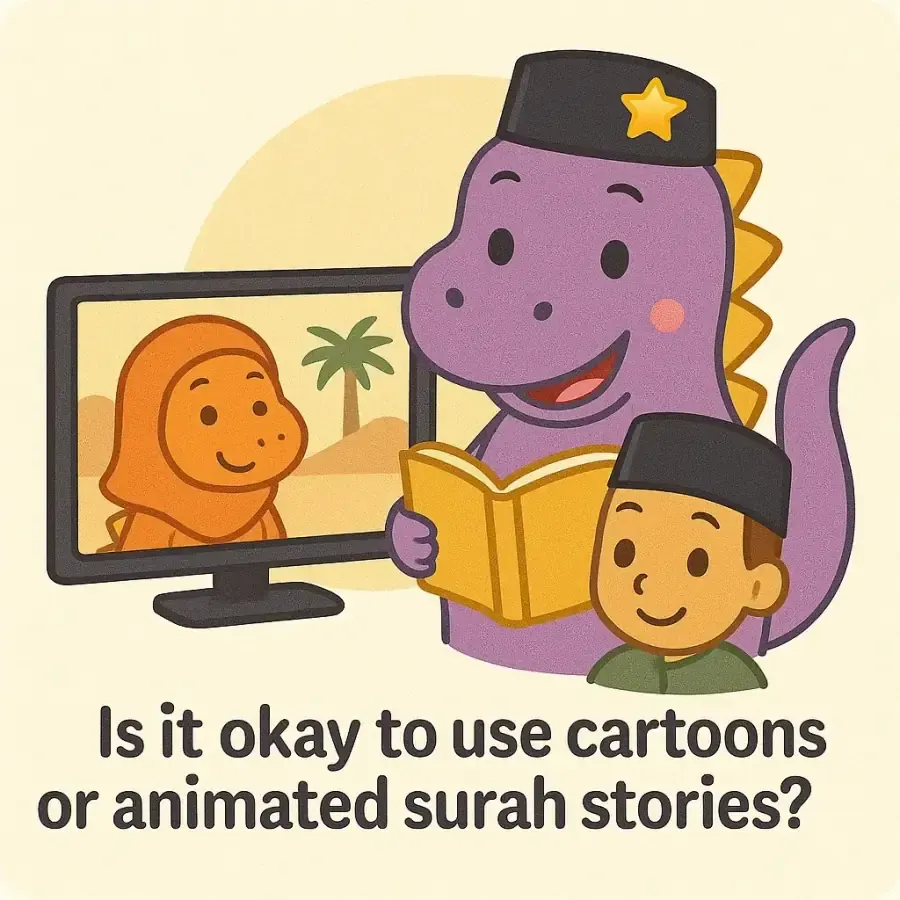
Young children may enjoy pictures, puppets or a map. Older children may enjoy a moral dilemma, or comparing the choices different people made in a story. We never show prophets in pictures; our puppets and pictures are of animals, places, landscapes and objects.
When a child asks, "Did this really happen?", you can answer that Muslims believe the Quran's accounts are true, while separating the Quran's text from details an illustrator added. For a detail you aren't sure about, say, "The Quran doesn't tell us that part."
Try this week
Pick one story your child already knows. Retell it using the four steps above, and end by reading the verse together.