Parent questions
Is it okay to use cartoons or animated surah stories?
Animation can help, but check it first. Five questions to ask before and after your child watches.
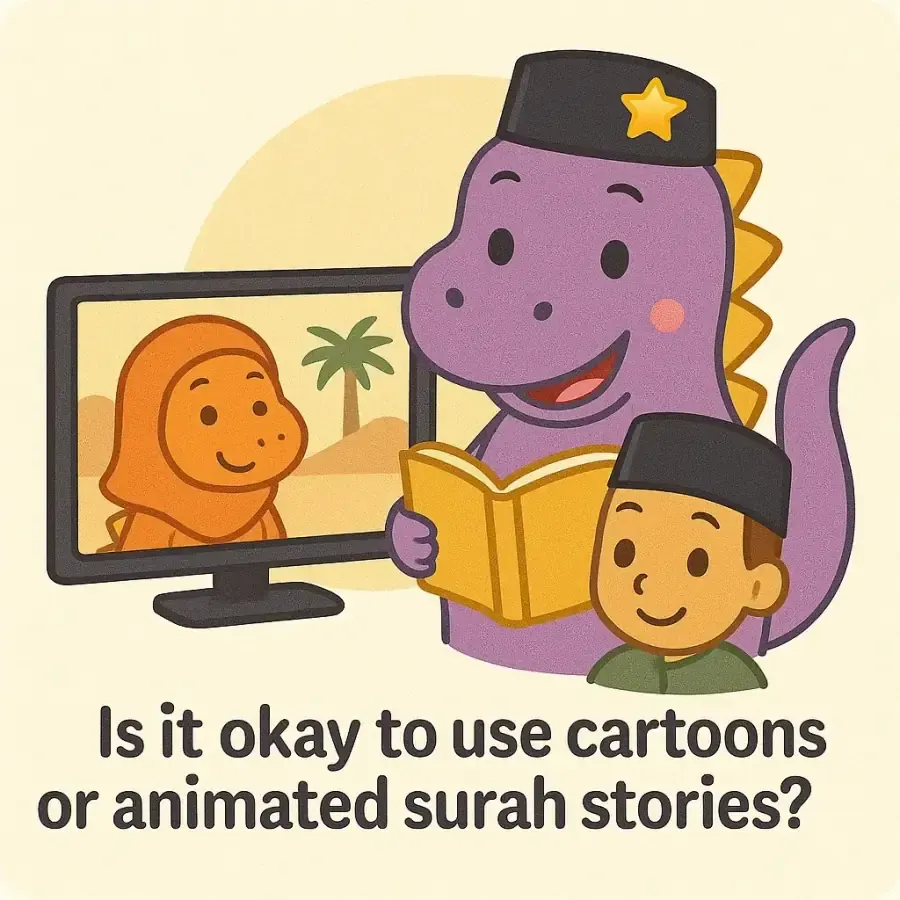
A friend sends you a brightly coloured cartoon called "The Story of Surah Al-Fil". It has smiling animals and a catchy tune, and your child loves it. Is this a good way to learn the Quran?
Animation can be a helpful way to teach, but its religious accuracy and presentation need checking. Scholars also differ on some questions of depiction and imagery, so follow the guidance of your trusted teachers.
Check 1: does it start from the source?
If a video teaches the story of the People of the Elephant, compare it with Surah Al-Fil and an accepted tafsir. Some storytellers invent names, thoughts and conversations for drama. That should never be passed off as revealed information or verified history. For young children, the safest choice is a story with no invented sacred details at all.
Check 2: are the Arabic verses accurate?
An animation can have a wonderful voice actor and still contain pronunciation mistakes, cut-off verses or subtitles that don't match. Quranic words must not be remixed into novelty songs. Songs about manners or vocabulary should be clearly separate from recitation.
Check 3: does it show sacred figures or the unseen carelessly?
Depicting prophets is especially sensitive and is widely rejected in Sunni educational settings. We don't show prophets anywhere on our sites, and our dino never plays a prophet or a companion. Look for landscapes, objects, paths, boats, caves and narration instead. Nothing should try to show Allah, or the exact form of unseen things such as angels or Paradise.
Check 4: what feeling does it leave?
A harsh scene of punishment can frighten a child, and treating revelation as a joke can confuse them. Wonder, reverence and a child-friendly tone can go together. If there is humour, it should be about a character's situation, not about sacred text or worship.
Check 5: what happens afterwards?
Ask one clear question, go back to a trusted verse or translation, and let your child show what they understood by talking, drawing or doing. A child who can retell every animated scene but can't tell what the Quran itself says needs help seeing the difference.
For example, after a cartoon about Prophet Yunus (peace be upon him), you might say, "The Quran tells us he was swallowed by the great fish. Let's look at the passage together," and read Surah As-Saffat 37:139–148. If the animation invented a conversation with the fish, say, "That was added by the artists. The Quran doesn't describe that conversation."
A child's own version
Children can also make their own. When Nurin was in primary school, she started a little book called "Surah Al-Fil: The Elephant". It opens with "Surah Al-fil is my favourite surah" and tells the story page by page in her own words, with space left for pictures she meant to draw. The last two pages teach the reader how to draw an elephant in six steps, so the book ends with her teaching someone else. It is a child's reflection, not a translation.
Try this week
Before your child watches, go through the five checks yourself. Afterwards, ask, "What does the Quran say about this?" and read the passage together.